Airport guide

Cam Ranh International Airport

Cam Ranh International Airport is the principal air gateway to Khánh Hòa and the main commercial airport serving the Nha Trang–Cam Ranh tourism corridor. Domestic passengers use Terminal T1 and international passengers use Terminal T2. T2 entered operation in 2018 with about 50,500 m² of floor area. The airport's runway 02R/20L entered operation on 10 October 2019 and measures about 3,048 m × 45 m, providing Code E aircraft capability. Decision 872/QĐ-BXD dated 5 June 2026 is the current airport-specific planning baseline: it sets ICAO Code 4E capacity of about 19 million passengers and 50,000 tonnes of cargo per year by 2030, rising to about 36 million passengers and 100,000 tonnes by 2050. Planned new terminal, apron and runway works must remain clearly separated from infrastructure already operating today.

CXR
Overview

Understand the airport as a journey, a gateway and a regional transport system.

Cam Ranh International Airport sits in Bắc Cam Ranh, Khánh Hòa, south of Nha Trang and immediately beside the Bãi Dài resort corridor. Its operating passenger system is split between domestic Terminal T1 and international Terminal T2, giving the airport a strong destination-airport identity shaped by leisure traffic and resort transfers. T2 opened in 2018 and has about 50,500 m² of usable floor area. Runway 02R/20L entered service on 10 October 2019 at about 3,048 m × 45 m and supports Code E operations. The approved June 2026 master plan provides a much larger future framework, including a western runway alignment, apron expansion, a larger T1 complex, T2 expansion and eventually Terminal T3. These are planning and implementation targets, not a description of the airport's present built capacity.

Key things to understand

  • Cam Ranh is Khánh Hòa's principal international aviation gateway and the main airport serving Nha Trang.
  • Domestic passenger operations use T1, while international passenger operations use T2.
  • International Terminal T2 entered operation in 2018 and has about 50,500 m² of usable floor area.
  • Runway 02R/20L entered operation on 10 October 2019 at about 3,048 m × 45 m.
  • The operating airfield supports Code E aircraft, including wide-body types used by international leisure markets.
  • Cam Ranh has unusually strong international-tourism exposure for a Vietnamese regional airport.
  • Decision 872/QĐ-BXD dated 5 June 2026 is the current airport-specific planning baseline.
  • The approved 2030 framework targets about 19 million passengers, 50,000 tonnes of cargo and around 45 aircraft stands.
  • The 2050 framework reaches about 36 million passengers, 100,000 tonnes of cargo and around 70 aircraft stands.
  • Current September 2026 schedules confirm nonstop links with Hanoi, Ho Chi Minh City, Da Nang and Hai Phong.
Why it matters

Read the airport as a system, not just a terminal

Strategic role

Cam Ranh converts Khánh Hòa's resort coast into an internationally accessible destination and is one of the province's most consequential pieces of visitor and investment infrastructure.

What makes it distinctive

Its international passenger mix, resort-corridor location and destination-airport character distinguish it from more domestically focused regional airports.

What users often miss

The airport is already a substantial two-terminal international gateway, but the 19-million and 36-million passenger figures describe approved future planning scales rather than today's operating throughput.

In one sentence

Cam Ranh is Khánh Hòa's main international airport, with domestic T1, international T2 and Code E runway capability; the approved June 2026 master plan expands it toward 19 million passengers by 2030 and 36 million by 2050.

Airport identity

What role does this airport actually play?

Role
Principal international aviation gateway for Khánh Hòa.
Passenger Role
Serves domestic travelers, international visitors, resort traffic and business travel across the Nha Trang–Cam Ranh corridor.
Cargo Role
Supports regional freight and time-sensitive goods, although passenger and tourism traffic dominate the airport's public-facing role.
Economic Role
Supports Nha Trang, Bãi Dài, Cam Ranh and the wider province's tourism, services and investment economy.
Strategic Role
Provides direct national and international air access to one of Vietnam's largest resort markets.
Core Insight
Cam Ranh is already a substantial international gateway, but its approved 19-million and 36-million passenger figures describe future planning capacity rather than current throughput.
Airport essentials

Navigate the terminals without guesswork

Terminals

T1

Terminal T1

Current domestic passenger terminal

Use this terminal for
Domestic passenger processing
Capacity
Current operating domestic terminal; future expansion is planned
The 2026 master plan provides a new T1 connected with the existing T1, creating a larger future domestic-terminal complex. Do not present the planned new T1 as operating.
T2

Terminal T2

Current international passenger terminal

Use this terminal for
International passenger processing
Capacity
About 2.4–4.8 million international passengers/year in the initial operating development range
T2 entered operation in 2018 and has about 50,500 m² of usable floor area. The approved 2030 plan provides further expansion toward about 8 million passengers/year.
T3 · planned

Terminal T3

Future passenger terminal

Use this terminal for
Additional passenger-processing capacity in the 2050 planning horizon
Capacity
About 14 million passengers/year under the approved 2050 framework
T3 is a future planning component and is not an operating passenger terminal.
Passenger journey

From check-in to the city — follow the flow

Arrival and departure flow

Current Domestic Departure
  • Confirm that the flight uses Terminal T1.
  • Check in and drop baggage.
  • Pass aviation security.
  • Proceed to the assigned gate.
  • Board.
Current International Departure
  • Confirm that the flight uses Terminal T2.
  • Check in and drop baggage.
  • Complete outbound immigration and other formalities.
  • Pass aviation security.
  • Proceed to the assigned gate or boarding bridge.
Current International Arrival
  • Disembark at Terminal T2.
  • Complete immigration.
  • Collect checked baggage.
  • Complete customs procedures.
  • Enter the arrivals hall and continue by road.
Planning Advice
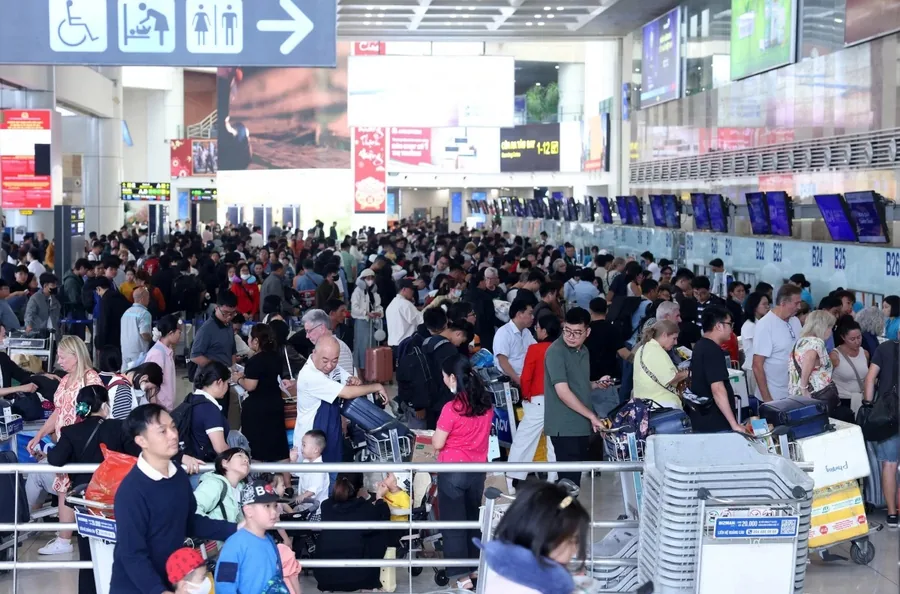
International leisure peaks can concentrate large tour groups, so allow additional processing and ground-transfer time.

Transfer strategy

Domestic ↔ internationalT1 ↔ T2

Confirm baggage through-check, immigration and terminal-change requirements with the airline before travel.

Resort / city transferGround transport

For most visitors the key onward journey is by road to Bãi Dài, Cam Ranh, Nha Trang or another Khánh Hòa destination.

Getting connected

Reach the city, the region and the wider air network

Surface access

Nha Trang
Road transfer north via the Nguyễn Tất Thành coastal corridor is the principal airport-to-Nha Trang movement.
Bai Dai
The Bãi Dài resort corridor lies directly along the airport–Nha Trang coastal axis.
Cam Ranh
Cam Ranh urban and bay areas are reached by local road connections.
South Province
Longer road transfers continue toward Vĩnh Hy, Núi Chúa, Ninh Chữ and other southern Khánh Hòa destinations.
Regional Network
National Highway 1 and the North–South Expressway support longer-distance movement along the province.
Planning Rule
Avoid hard-coded travel times because traffic, resort location and road conditions vary.

Air connectivity

Domestic Role
Cam Ranh links Khánh Hòa directly with Vietnam's largest domestic aviation markets and selected regional cities.
Verified Domestic Links September2026
Current schedules confirm nonstop services with Hanoi, Ho Chi Minh City, Da Nang and Hai Phong.
International Role
International traffic is central to the airport's identity, particularly tourism-oriented markets in Northeast Asia, Central Asia and Russia.
International Caution
International routes can be seasonal or charter-oriented and should be verified before travel.
Route Rule
Airlines, routes and frequencies are time-sensitive and must be checked before publication as current service.
At the airport

Services, accessibility and practical preparation

Passenger services

T1
T1 provides domestic check-in, security, baggage handling and boarding facilities.
T2
T2 provides international check-in, immigration, customs, security, baggage handling and passenger boarding facilities.
Retail And Food
Food, beverage, retail and duty-free services are available, particularly in the international terminal.
Tourism Orientation
Ground handling and arrivals activity are strongly shaped by international leisure groups and resort transfers.
Editorial Rule
Individual shops, lounges, counters and operators can change.

Accessibility

Terminal Environment
T2 is a modern multi-level international terminal with lifts, escalators and passenger-processing infrastructure.
Assistance
Passengers requiring mobility, boarding or special assistance should arrange support with their airline in advance.
Group Travel
Large tour groups should coordinate meeting points and transport in the arrivals area.
Editorial Rule
Do not claim specific accessibility certification without direct verification.

Family travel

Strengths
  • Modern international T2
  • Direct access to the Bãi Dài resort corridor
  • Wide range of tourism-transfer options
  • Clear separation between domestic and international terminal functions
Planning
  • Confirm T1 versus T2 before departure.
  • Allow extra time during international group-tour peaks.
  • Pre-book child seats or larger vehicles where required.
  • Carry essentials for longer transfers beyond Cam Ranh and Nha Trang.

Before you travel

  • Check whether the flight uses domestic T1 or international T2.
  • Verify live flight status and terminal information.
  • Allow extra time during international leisure peaks.
  • Pre-arrange resort transfers when arriving late or in a group.
  • Do not describe the planned new T1 or T3 as operating.
  • Use 19 million passengers/year only as the approved 2030 airport planning capacity.
  • Use 36 million passengers/year only as the approved 2050 planning capacity.
  • Check severe-weather conditions before travel.
Operating conditions

Plan for peaks, weather and disruption

Peak periods

International Tourism
Peak inbound tourism seasons can produce concentrated international arrivals and departures.
Summer
Vietnamese summer holidays increase domestic resort demand.
Holidays
Tet and national holidays can increase domestic traffic.
Market Peaks
Russian, Korean, Chinese and other international markets can have strong seasonal patterns.
Planning Advice
  • Book early in peak periods.
  • Expect group-tour activity at T2.
  • Confirm transport with resorts or hotels.
  • Check schedule changes before leaving for the airport.

Weather and disruption

Coastal Climate
Cam Ranh has a relatively dry south-central coastal climate compared with many central Vietnamese destinations.
Storm Season
Tropical storms and heavy rain can still affect aviation and surface access.
Wind
Coastal winds can affect operations and marine-tourism connections.
Heat
High temperatures can affect ground comfort and road transfers.
Passenger Rule
Use live airline, airport and weather information during severe conditions.

Security and processing

Joint Use
Cam Ranh is a joint civil-military airport.
Current Runway
Runway 02R/20L is about 3,048 m × 45 m and entered operation in October 2019.
Widebody Capability
The operating airfield supports Code E aircraft used on long-haul and high-capacity international services.
International Processing
T2 provides immigration, customs and international security functions.
Approved Planning Class
The approved 2026 plan uses ICAO Code 4E through the 2030 and 2050 planning horizons.
Editorial Rule
Respect restrictions around military and controlled airside infrastructure.
Airport intelligence

Capacity, growth and the airport's next chapter

Recent capacity development

Current Context
The airport already operates domestic T1, international T2 and Code E runway capability, but future master-plan capacity should not be treated as present built capacity.
Approved2030 Passengers
About 19 million passengers/year.
Approved2030 Cargo
About 50,000 tonnes/year.
Approved2030 Class
ICAO Code 4E.
Approved2030 Runway System
Retain 02R/20L and develop 02L/20R at about 3,350 m × 45 m in the western alignment described by the 2026 plan.
Approved2030 Apron
About 45 aircraft stands.
Approved2030 Terminals
T1 complex about 11 million passengers/year plus expanded T2 about 8 million passengers/year.
Approved2050 Passengers
About 36 million passengers/year.
Approved2050 Cargo
About 100,000 tonnes/year.
Approved2050 Apron
About 70 aircraft stands.
Approved2050 Terminals
T1 about 14 million passengers/year, T3 about 14 million and continued T2 operation.
Status Rule
Approved planning capacity is not the same as infrastructure already constructed or commissioned.

Current operations

Status
Operating international airport.
Passenger Facilities
Domestic T1 and international T2.
T2 Status
Operating since 2018.
Runway02 R20 L
Operating since 10 October 2019; about 3,048 m × 45 m.
Widebody Capability
Code E aircraft capability is established.
2026 Traffic
ACV reported about 4.1 million passengers in the first six months of 2026, including nearly 2.6 million international passengers; full-year traffic was projected at about 8.3 million.
Status Caution
The new T1, 45-stand 2030 apron, western runway development and T3 should not be represented as fully operating unless implementation evidence confirms completion.

Long-term airport planning

Legal Basis
Decision 872/QĐ-BXD dated 5 June 2026, approving the Cam Ranh International Airport plan for 2021–2030 with vision to 2050.
Location
Bắc Cam Ranh ward, Khánh Hòa province.
2030 Class
ICAO Code 4E.
2030 Passengers
About 19 million passengers/year.
2030 Cargo
About 50,000 tonnes/year.
2030 Aircraft
Planning accommodates B747, B777, B787, A350, A321 and equivalent aircraft.
2030 Runway System
Retain 02R/20L; develop 02L/20R at about 3,350 m × 45 m in the western alignment described by the approved plan.
2030 Apron
About 45 aircraft stands.
2030 T1
New T1 connected with existing T1 for about 11 million passengers/year.
2030 T2
Expand T2 to about 8 million passengers/year.
2030 Cargo Terminal
About 50,000 tonnes/year north of T2.
2050 Passengers
About 36 million passengers/year.
2050 Cargo
About 100,000 tonnes/year.
2050 Apron
About 70 aircraft stands.
2050 T1
About 14 million passengers/year.
2050 T3
New passenger terminal south of the passenger complex, about 14 million passengers/year.
General Aviation
About 1.57 ha reserved between T1 and T3 for general aviation facilities.
Land
About 628.41 ha total airport land requirement.
Editorial Rule
Decision 872/QĐ-BXD is the primary current airport-specific planning baseline; older forward-looking proposals with different capacity assumptions should be treated as superseded.
Cargo and investment

See the airport as part of its regional economic network

Cargo gateway

Current Role
Passenger and tourism traffic dominate the airport's public identity, while cargo supports the wider regional economy.
2026 Traffic
ACV reported 7,453 tonnes of cargo in the first six months of 2026 and projected more than 15,127 tonnes for the full year.
Approved2030 Capacity
About 50,000 tonnes/year.
Approved2030 Facility
New cargo terminal planned north of T2.
Approved2050 Capacity
About 100,000 tonnes/year.
Opportunity
  • Seafood and aquaculture
  • High-value agriculture
  • Express logistics
  • Tourism and hospitality supply chains
  • Time-sensitive goods
Editorial Rule
Actual throughput, terminal design capacity and master-plan capacity are different measures.

Regional investment impact

Tourism
The airport is fundamental to Nha Trang, Bãi Dài, Cam Ranh and the province's international resort economy.
International Markets
Direct overseas services reduce dependence on Hanoi or Ho Chi Minh City connections and support high-volume inbound tourism.
Bai Dai
The airport is immediately adjacent to one of Vietnam's major resort-development corridors.
Cam Ranh Economy
Aviation complements Cam Ranh's maritime, logistics and urban economy.
Expanded Province
The enlarged province broadens the airport's potential tourism and investment reach across a much longer north–south coastal geography.
Future Scale
The approved 19-million-passenger 2030 framework is intended to create headroom for strong tourism and economic growth.
Economic reach

Industrial catchment

01

Bai Dai–Cam Lam–Cam Ranh

Resorts, hospitality, urban development and services

Immediate airport tourism and investment catchment.
02

Nha Trang

Tourism, services, healthcare, education, meetings and urban economy

Largest established passenger-demand centre.
03

Cam Ranh maritime economy

Port, logistics, marine services and industry

Air access for business, specialists and higher-value logistics.
04

Van Phong–Ninh Hoa

Port, industry, logistics and northern tourism

Business and visitor access, though ground distances are longer.

Investor checklist

  • Use cam-ranh-international-airport consistently for standalone id, slug and Province Profile entityRef.
  • Use khanh-hoa as provinceSlug.
  • Treat T1 and international T2 as operating.
  • Treat T2 as operating since 2018.
  • Use about 3,048 m × 45 m for operating runway 02R/20L.
  • Use Decision 872/QĐ-BXD as the primary airport-specific future-planning baseline.
  • Use about 19 million passengers/year and 50,000 tonnes/year for approved 2030 airport capacity.
  • Use about 45 aircraft stands for the approved 2030 apron plan.
  • Use about 36 million passengers/year and 100,000 tonnes/year for the 2050 planning horizon.
  • Treat T3 as a future 2050 component.
  • Do not confuse current traffic, terminal capacity and master-plan capacity.
  • Verify airline routes and frequencies before using them in investment analysis.
Business and investment

Use the airport as a regional decision-making lens

Business travel

Strengths
  • Strong domestic and international network
  • Direct access to Cam Ranh and Bãi Dài
  • Modern international T2
  • Code E aircraft capability
  • Established road link toward Nha Trang
Limitations
  • Nha Trang city centre is not adjacent to the airport
  • International schedules are strongly tourism-market dependent
  • The enlarged province creates long north–south ground distances
Decision Rule
Cam Ranh is the natural airport for business across the Nha Trang–Cam Ranh core and a major gateway for the wider province; road or rail may be more efficient for some shorter regional journeys.

Air vs road vs rail vs sea

Air
Best for long-distance domestic and international access to Khánh Hòa.
Rail
The North–South Railway serves Nha Trang, Cam Ranh and other points and can be attractive for regional city-centre travel.
Road
National Highway 1 and the North–South Expressway support movement along the province's long coastal axis.
Sea
Ports at Cam Ranh and Vân Phong serve maritime functions rather than substituting for mainstream passenger aviation.
Decision Rule
Air dominates long-distance tourism access; rail and road become increasingly competitive for regional journeys and multi-stop travel.
Know before you assume

Common airport misconceptions

Airport evolution

How the gateway has changed

Civil aviation shifts from Nha Trang to Cam Ranh

Cam Ranh became the commercial aviation gateway serving the Nha Trang region.

International-airport role strengthens

National planning reinforced Cam Ranh's long-term international aviation role.

Second-runway project begins

Construction of runway 02R/20L began as greater airfield capacity was developed.

International Terminal T2 opens

The approximately 50,500 m² international terminal entered operation.

Runway 02R/20L enters service

The approximately 3,048 m × 45 m runway entered operation with Code E aircraft capability.

Pre-pandemic traffic reaches a major peak

Airport traffic reached approximately 9.75 million passengers before the global pandemic disrupted aviation.

International leisure markets recover

Russian and other overseas tourism markets continued rebuilding direct traffic to Cam Ranh.

New airport master plan approved

Decision 872/QĐ-BXD set the 2030 planning capacity at about 19 million passengers and the 2050 vision at about 36 million.

Connections

Explore Vietnam's aviation network

Understand aviation

Airport terms worth knowing

A compact reference for the terminology used throughout this dashboard.

CXR

IATA airport code for Cam Ranh International Airport.

T1

The current domestic passenger terminal; a larger connected T1 complex is planned.

T2

The current international passenger terminal, opened in 2018.

T3

A future passenger terminal planned for the 2050 horizon.

ICAO Code 4E

The airport-reference-code scale used by the approved 2026 Cam Ranh master plan.

Design capacity

Infrastructure-handling capacity used for planning or terminal design; it is different from actual annual traffic.

Sources

Where this airport guide comes from

Ministry of Construction

Decision 872/QĐ-BXD approving Cam Ranh International Airport planning for 2021–2030, vision to 2050

Current approved airport-specific planning baseline.

Ministry of Construction

Approval of Cam Ranh International Airport planning for 2021–2030, vision to 2050

2030 and 2050 capacity, Code 4E and aircraft-planning framework.

Airports Corporation of Vietnam

Cam Ranh International Airport T2 enters operation

T2 operating status and terminal development.

Airports Corporation of Vietnam

Cam Ranh International Airport puts runway 2 into operation

Runway 02R/20L commissioning, dimensions and Code E capability.

Vietnam Airlines

Flights from Nha Trang to Hanoi

September 2026 verification of CXR–HAN service.

Vietnam Airlines

Flights from Nha Trang to Ho Chi Minh City

September 2026 verification of CXR–SGN service.

FlightConnections

Flights from Nha Trang to Da Nang

September 2026 verification of nonstop CXR–DAD service.

FlightConnections

Flights from Nha Trang to Hai Phong

September 2026 verification of nonstop CXR–HPH service.