Airport guide

Tan Son Nhat International Airport

Tan Son Nhat International Airport is the principal airport serving Ho Chi Minh City and one of Vietnam's busiest aviation gateways. Its three-terminal system now separates international traffic at T2 from domestic traffic divided between T1 and the new T3, whose 2025 opening lifted the airport's designed passenger capacity to about 50 million passengers per year.

SGN · Ho Chi Minh City
Overview

Understand the airport as a journey, a gateway and a regional transport system.

Tan Son Nhat International Airport is the main aviation gateway for Ho Chi Minh City and a critical transport node for southern Vietnam. Unlike an outlying greenfield airport, it sits within the dense metropolitan fabric, making it exceptionally convenient for central-city access while also exposing operations and passengers to road congestion and constrained airport land. The airport now operates three passenger terminals: T1 and T3 for domestic flights and T2 for international flights. Terminal 3 opened in April 2025 with a design capacity of 20 million passengers per year, 112,500 m² of terminal floor area, 90 check-in counters, 20 self-service bag-drop counters, 42 self-check-in kiosks and 27 boarding gates. By the 2026 Lunar New Year peak, Tan Son Nhat reported 61 airlines in operation and planned for about 145,000 passengers and 940 flights per day on average, with the busiest day potentially exceeding 1,000 flights. The airport should therefore be understood not only as a passenger gateway but as a metropolitan mobility system whose performance depends on terminal assignment, airfield capacity, road access, digital processing and its evolving relationship with Long Thanh International Airport.

Key things to understand

  • Confirm your terminal before travelling: international flights use T2, while domestic flights are split between T1 and T3.
  • As of the 2026 Lunar New Year operating plan, VietJet Air domestic flights remain at T1 while Vietnam Airlines, Pacific Airlines, VASCO, Bamboo Airways, Vietravel Airlines and Sun PhuQuoc Airways domestic operations use T3.
  • Use official airport or airline information because domestic terminal assignments can change.
  • Free airport shuttle buses connect T1, T2 and T3; operating times and frequency should be rechecked before travel.
  • Allow a substantial road-traffic buffer because the airport is embedded in a dense urban area and access time can vary sharply by time of day.
  • Do not treat the short geographic distance from central Ho Chi Minh City as a guaranteed short journey.
  • For domestic–international connections, account separately for terminal transfer, baggage, security and immigration.
  • T3 has materially expanded domestic passenger-processing capacity, but runway, taxiway, apron and surrounding-road constraints remain separate issues.
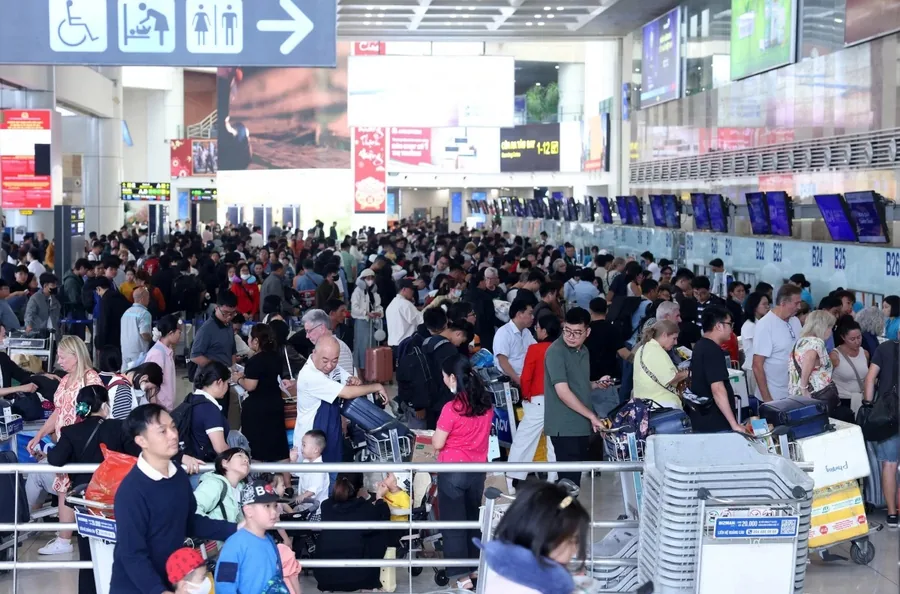
  • During Tet and major holidays, passenger volumes can rise above 140,000 per day and aircraft movements can exceed 1,000 on the busiest days.
  • Long Thanh International Airport changes the long-term aviation geography of the Ho Chi Minh City region, so Tan Son Nhat should increasingly be analyzed as part of a multi-airport system.
Why it matters

Read the airport as a system, not just a terminal

Strategic role

Tan Son Nhat is the aviation front door to Vietnam's largest commercial metropolis. Its combination of urban proximity, enormous passenger demand and national/international connectivity makes it one of the country's most strategically important transport assets.

What makes it distinctive

Few major airports in Vietnam are as deeply embedded in the urban fabric. That creates an unusual combination of exceptional city access and severe pressure on roads, terminal circulation and constrained airport land.

What users often miss

After T3 opened, the key passenger question is no longer simply domestic versus international. Domestic travelers must also distinguish between T1 and T3, while planners must distinguish terminal capacity from airfield and metropolitan-access capacity.

In one sentence

It is Ho Chi Minh City's main airport—close to downtown, exceptionally busy, and now operating as a three-terminal system.

Airport identity

What role does this airport actually play?

Role
Primary operating airport for Ho Chi Minh City and a major national aviation gateway.
Passenger Role
Serves Vietnam's largest metropolitan air-travel market across domestic trunk routes and extensive international networks.
Cargo Role
Supports time-sensitive cargo, express shipments and the wider southern business economy, although future regional cargo roles will increasingly interact with Long Thanh.
Economic Role
Connects Ho Chi Minh City's finance, services, manufacturing, tourism and commercial economy with domestic and global markets.
Strategic Role
A key component of the emerging multi-airport system serving the Ho Chi Minh City metropolitan region.
Core Insight
Tan Son Nhat's defining advantage is metropolitan proximity; its defining constraint is operating a very high-volume airport within a dense urban environment.
Airport essentials

Navigate the terminals without guesswork

Terminals

T1

Terminal 1

Domestic passenger terminal

Use this terminal for
Domestic operations assigned to airlines remaining at T1
Terminal assignments are operational data and should be reverified before publication.
T2

Terminal 2

International passenger terminal

Use this terminal for
International arrivals and departures
International passengers should continue to verify airline counters, immigration procedures and current processing arrangements.
T3

Terminal 3

New domestic passenger terminal

Use this terminal for
Domestic flights transferred from T1 according to airline operating plans
Capacity
20 million passengers/year design capacity
T3 is designed to reduce pressure on T1 and modernize domestic passenger processing.
Passenger journey

From check-in to the city — follow the flow

Arrival and departure flow

Domestic Departure
  • Confirm whether the flight uses T1 or T3.
  • Complete airline check-in or eligible self-service processing.
  • Drop checked baggage if required.
  • Pass aviation security.
  • Proceed to the assigned gate.
International Departure
  • Confirm T2.
  • Complete airline check-in and baggage drop.
  • Complete outbound immigration where required.
  • Pass security screening.
  • Proceed to the international departure gate.
International Arrival
  • Immigration
  • Baggage reclaim
  • Customs
  • Public arrivals hall
  • Surface transport
Transfer Rule
Domestic connections can require a T1–T3 transfer, while domestic–international journeys can require movement between T1/T3 and T2.
Editorial Rule
Do not publish one universal minimum connection time without verifying airline, baggage and itinerary conditions.

Transfer strategy

International → InternationalUsually T2

Follow airline and international-transfer instructions; baggage and immigration requirements depend on itinerary.

International → DomesticT2 → T1 or T3

Immigration, baggage/customs where applicable, terminal transfer and domestic security.

Domestic → InternationalT1 or T3 → T2

Allow for road/terminal shuttle transfer plus international check-in, immigration and security.

Domestic → DomesticT1, T3 or inter-terminal

Terminal depends on airline; a connection between airlines may require T1–T3 transfer.

Getting connected

Reach the city, the region and the wider air network

Surface access

Central Ho Chi Minh City
Tan Son Nhat is unusually close to the urban core, but travel time depends heavily on congestion and the exact terminal approach.
Main Road Context
Access relies on dense metropolitan road networks around Truong Son, Cong Hoa, Hoang Van Thu and connecting corridors, with terminal-specific approaches becoming increasingly important after T3 opened.
Taxi
Licensed taxi services operate at the airport; pickup locations vary by terminal.
Ride Hailing
App-based transport is widely used, but pickup zones and airport operating rules should be checked dynamically.
Bus
Public bus services connect the airport with parts of Ho Chi Minh City; route numbers and operating times should remain dynamic.
Private Transfer
Useful for hotels, business travelers, groups and passengers with substantial luggage.
Parking
Parking and commercial parking facilities are available, including major new facilities associated with T3.
Planning Rule
Always evaluate terminal-specific road access and peak traffic rather than quoting a single airport-to-city travel time.

Air connectivity

Domestic
  • Ha Noi
  • Da Nang
  • Central Vietnam
  • Mekong Delta and southern destinations
  • Highlands and coastal tourism gateways
  • Island destinations
International Regions
  • Northeast Asia
  • Southeast Asia
  • South Asia
  • Middle East
  • Europe
  • Australia and connecting long-haul networks
Network Trend
Tan Son Nhat remains one of Vietnam's largest international and domestic air markets while the regional network begins transitioning toward a future dual-airport structure with Long Thanh.
Data Rule
Maintain airline and destination lists dynamically because routes, frequencies and terminal assignments change.
At the airport

Services, accessibility and practical preparation

Passenger services

Information
Passenger information and flight-information services are available across the terminal system.
Wifi
Airport Wi-Fi is available; connection methods may change.
Lounges
Airline and commercial lounges operate subject to terminal, eligibility and current contracts.
Food
Restaurants, cafés and convenience services operate in passenger areas.
Shopping
Retail and duty-free services are available, particularly in international areas.
Medical
Airport medical and emergency services form part of airport operations.
T3 Amenities
ACV has highlighted free drinking-water stations, charging facilities, Wi-Fi, food, shopping and lounge services at T3.
Special Assistance
Passengers requiring mobility or other assistance should coordinate with their airline before travel.

Accessibility

Terminal Environment
Passenger terminals use lifts, escalators and managed circulation systems, with T3 designed as a modern high-capacity facility.
Airline Assistance
Wheelchair and boarding assistance should be requested through the airline.
Terminal Transfer
Passengers with limited mobility should allow additional time and verify the most suitable shuttle or assisted-transfer option.
Road Access
Drop-off and pickup arrangements differ by terminal and should be confirmed in advance.
Editorial Rule
Do not claim universal accessibility for every gate, airline or transfer path without current verification.

Family travel

Planning
  • Confirm T1, T2 or T3 before departure.
  • Allow extra time for road congestion.
  • Keep travel documents and boarding passes organized.
  • Use lifts where practical with children and luggage.
  • Plan meals, water and restroom stops before boarding.
  • Check airline stroller, infant and family-seating rules.
Peak Risk
Tet, summer and holidays can make terminal and road navigation significantly more demanding for families.
Terminal Benefit
T3 adds space, self-service processing and modern passenger amenities for domestic journeys.

Before you travel

  • Confirm airline, flight and terminal.
  • For domestic flights, verify T1 versus T3.
  • For international flights, use T2 unless the airport or airline states otherwise.
  • Check passport, visa and baggage requirements.
  • Allow a road-congestion buffer.
  • Allow extra time during Tet and holidays.
  • Use current official terminal-transfer guidance.
  • Confirm ride-hailing, taxi or bus pickup zone.
  • Monitor weather and flight status.
  • Do not rely on an old screenshot of terminal assignment.
Operating conditions

Plan for peaks, weather and disruption

Peak periods

Tet
The most operationally demanding annual period, with intense domestic and international demand.
Summer
Strong family, tourism and domestic leisure traffic.
Public Holidays
National holidays can produce concentrated surges.
2026 Tet
Tan Son Nhat planned for about 145,000 passengers per day and 940 flights per day on average, with the busiest day potentially reaching about 1,025 flights.
Planning Advice
  • Confirm terminal before leaving.
  • Arrive according to current airline and airport recommendations.
  • Use online or self-service check-in where eligible.
  • Allow additional road-traffic time.
  • Monitor flight and airport notices.
  • Avoid tight inter-terminal connections.

Weather and disruption

Thunderstorms
Convective weather during the rainy season can affect ramp activity, sequencing and flight punctuality.
Heavy Rain
Intense tropical rainfall can slow road access and airport ground operations.
Regional Weather
Weather at destination airports can disrupt the network even when conditions at Tan Son Nhat are acceptable.
Air Traffic
Very high movement volumes during peak periods can amplify delay propagation.
Passenger Rule
Check both airline flight status and airport operational notices during disruption.

Security and processing

Check In
Use airline counters or self-service options where supported; T3 was designed with extensive automated processing.
Security
Passengers must complete aviation-security screening according to their itinerary and terminal.
Immigration
International passengers use immigration controls at T2 according to nationality and itinerary.
Customs
International baggage and goods remain subject to Vietnamese customs requirements.
Biometrics
Digital identity, e-gates and self-service processing are expanding, particularly at newer facilities, but availability depends on current implementation and passenger eligibility.
Editorial Rule
Do not state that every passenger or airline can use every automated or biometric process.
Airport intelligence

Capacity, growth and the airport's next chapter

Recent capacity development

Title
Passenger Terminal 3
Period
2022–2025
First Commercial Flight
17 April 2025
Official Inauguration
19 April 2025
Investment
Approximately VND10.99 trillion
Capacity
20 million passengers/year
Peak Hour Capacity
Approximately 7,000 passengers/hour
Floor Area
Approximately 112,500 m²
Check In Counters
90
Self Bag Drop Counters
20
Self Check In Kiosks
42
Boarding Gates
27
Passenger Boarding Bridges
13 gates served by boarding bridges in ACV project information
Security Checkpoints
25 passenger security screening checkpoints
Parking Complex
A major multi-storey parking and non-aviation services complex was developed as part of the T3 project.
Architectural Concept
ACV described the terminal design as inspired by the Vietnamese ao dai.
Digital Direction
Self-service check-in, self bag drop, e-gates and integrated digital passenger processing are central to the T3 operating concept.
Significance
T3 raised Tan Son Nhat's designed passenger capacity to approximately 50 million passengers per year and redistributed domestic traffic away from overloaded T1.

Current operations

Period
2025–2026 operating context
Nine Month2025 Passengers
30,513,797 passengers in the first nine months of 2025 according to Tan Son Nhat reporting
Nine Month2025 Passenger Growth
5.1% year on year
Nine Month2025 Flights
182,820 takeoffs/landings in the first nine months of 2025
Nine Month2025 Flight Growth
6.2% year on year
New Year2026 Planned Passengers
Approximately 131,000 passengers/day on average during the 2026 New Year period
New Year2026 Planned Flights
Approximately 760 flights/day on average
Tet2026 Planned Passengers
Approximately 145,000 passengers/day
Tet2026 Planned Flights
Approximately 940 flights/day on average; peak day potentially about 1,025
Airlines Tet2026
61 airlines
Terminal Allocation
T2 international; domestic operations split between T1 and T3
Interpretation
T3 has materially improved terminal capacity, but Tan Son Nhat remains a high-intensity metropolitan airport where airfield and ground-access management are critical.

Long-term airport planning

Long Term Direction
Tan Son Nhat is entering a new planning cycle as the Ho Chi Minh City region develops a multi-airport system centered on Tan Son Nhat and Long Thanh.
Current Planning Status
In December 2025, the Ministry of Construction approved the task of preparing Tan Son Nhat International Airport's 2021–2030 plan with a vision to 2050.
Planning Context
The new planning work is intended to optimize existing infrastructure, forecast aviation demand, organize airside and landside space and propose investment phasing.
Planning Need
  • Optimize runway and taxiway use
  • Coordinate T1, T2 and T3 terminal capacity
  • Improve terminal access roads
  • Manage apron and aircraft stands
  • Integrate digital passenger processing
  • Coordinate future roles with Long Thanh
  • Manage urban noise and land constraints
Investment Implication
Tan Son Nhat will remain strategically valuable because of its urban location even as Long Thanh absorbs a growing share of regional aviation demand.
Data Rule
Do not publish a new 2030/2050 airport-specific capacity target until the current airport planning process is formally approved.
Cargo and investment

See the airport as part of its regional economic network

Cargo gateway

Role
Important southern Vietnam air-freight and express gateway serving a large consumption and manufacturing market.
Strong Cargo Types
  • Express parcels
  • E-commerce shipments
  • High-value components
  • Time-sensitive industrial goods
  • Fashion and consumer products
  • Selected perishables
  • Belly cargo on international passenger flights
Industrial Link
The airport serves Ho Chi Minh City and manufacturing corridors across the wider southern economic region.
Regional Transition
Long Thanh International Airport is expected to alter the long-term distribution of passenger and cargo activity in the region.
Investment Insight
For urban and time-sensitive business, Tan Son Nhat's city proximity is valuable, but investors should model congestion and future airport-system changes.
Due Diligence
  • Cargo terminal capability
  • Customs and bonded logistics
  • Truck access during peak road periods
  • Airline cargo network
  • Warehouse location
  • Future Long Thanh allocation
  • Alternative seaport and road logistics

Regional investment impact

Aviation Access
Provides immediate air connectivity for Vietnam's largest commercial metropolis.
Business Access
Its urban location is especially valuable for executives, services, trade fairs, finance and short business trips.
Tourism
Acts as a primary gateway for Ho Chi Minh City and onward travel across southern Vietnam.
Logistics
Supports urgent, high-value and express flows in the southern economy.
Real Estate
Airport accessibility benefits hotels, offices, logistics and commercial districts, while noise and traffic can constrain airport-adjacent development.
Future System
Long Thanh creates a two-airport regional framework that will influence route allocation, logistics, property and transport investment.
Risk
Investment decisions should not assume today's traffic allocation between Tan Son Nhat and Long Thanh will remain unchanged.
Economic reach

Industrial catchment

01

Ho Chi Minh City

Finance, technology, services, trade, consumer market and manufacturing

Exceptional proximity for executive travel, tourism and time-sensitive business.
02

Binh Duong urban-industrial corridor

Major manufacturing and logistics concentration within the expanded metropolitan economy

Business travel and high-value logistics, subject to road congestion.
03

Dong Nai / Long Thanh corridor

Manufacturing, logistics and future airport-led development

Transitional relationship between Tan Son Nhat and Long Thanh airport access.
04

Southern industrial and port corridor

Export manufacturing, logistics and maritime trade

Air transport complements seaport and road logistics for urgent and high-value movements.

Investor checklist

  • Measure actual peak and off-peak road time to the relevant terminal.
  • Check route relevance to headquarters, customers and suppliers.
  • Assess future Long Thanh route and cargo allocation.
  • Review airport-adjacent noise and height-control constraints.
  • Evaluate logistics alternatives through southern seaports and Long Thanh.
  • Model executive travel under congestion conditions.
  • Check current cargo and customs capability.
  • Track the new Tan Son Nhat 2021–2030 / 2050 planning process.
  • Assess future metro and regional transport projects only by confirmed implementation status.
  • Do not treat T3 passenger capacity as equivalent to total airfield capacity.
Business and investment

Use the airport as a regional decision-making lens

Business travel

Strengths
  • Very close to central Ho Chi Minh City
  • Large domestic and international network
  • New T3 domestic capacity
  • Strong business and tourism market
  • Extensive ground-transport choices
Risks
  • Severe road congestion at peak periods
  • Terminal-assignment mistakes
  • T1–T3 and domestic–international transfer time
  • High peak passenger volumes
  • Weather and network disruption
Recommendation
For time-critical meetings, budget city-road access and terminal-processing time separately and verify the terminal immediately before departure.

Air vs road vs rail vs sea

Air
Best for long-distance passengers and urgent or high-value cargo.
Road
Critical because all passenger terminals currently depend heavily on metropolitan road access.
Rail
Future urban and regional rail integration is strategically important, but only operating infrastructure should be presented as current access.
Sea
Southern seaports handle much larger-volume maritime freight and complement air cargo.
System Insight
Tan Son Nhat's performance is inseparable from metropolitan ground transport and the future Long Thanh airport system.
Know before you assume

Common airport misconceptions

Airport evolution

How the gateway has changed

Tan Son Nhat develops into southern Vietnam's principal aviation gateway

The airport evolves through military and civil aviation eras into the main airport serving Ho Chi Minh City.

International Terminal 2 opens

A dedicated international terminal substantially upgrades international passenger processing and separates it from the older domestic terminal.

Passenger growth intensifies capacity pressure

Rapid growth in domestic and international demand places increasing pressure on terminals, airfield operations and surrounding roads.

Terminal 3 project construction begins

The major domestic-terminal project moves into construction with an investment of approximately VND10.99 trillion.

T3 handles its first commercial flight

Vietnam Airlines flight VN1286 from Ho Chi Minh City to Van Don becomes the first commercial departure handled at the new terminal.

Terminal 3 officially inaugurated

The 20-million-passenger-per-year domestic terminal is officially opened, materially expanding airport passenger capacity.

Vietnam Airlines domestic operations consolidate at T3

Vietnam Airlines transfers its remaining domestic operations to the new terminal, marking a major redistribution of traffic from T1.

More domestic airlines move to T3

Additional domestic carriers begin shifting operations to T3, while VietJet continues operating domestic flights from T1.

Three-terminal operating model matures

T2 continues serving international traffic while domestic services are divided between T1 and T3.

T3 supports a major peak-season test

Tan Son Nhat plans for about 145,000 passengers and 940 flights per day on average, demonstrating the scale of the airport's post-T3 operating environment.

Tan Son Nhat enters a new regional airport-planning era

Airport-specific planning and the development of Long Thanh increasingly shape the future division of aviation demand in the Ho Chi Minh City region.

Connections

Explore Vietnam's aviation network

Understand aviation

Airport terms worth knowing

A compact reference for the terminology used throughout this dashboard.

SGN

IATA airport code for Tan Son Nhat International Airport.

T1

One of Tan Son Nhat's domestic passenger terminals.

T2

International passenger terminal at Tan Son Nhat.

T3

Domestic passenger terminal opened in April 2025 with design capacity of 20 million passengers per year.

Airside

Restricted airport operational area beyond passenger security controls.

Landside

Public-access part of an airport before security-controlled areas.

Self bag drop

Automated facility allowing eligible passengers to tag and submit checked baggage with reduced counter interaction.

E-gate

Automated gate used in eligible passenger-processing or access-control workflows.

Boarding bridge

Enclosed bridge connecting a passenger terminal directly to an aircraft.

Peak hour

Period of highest passenger or aircraft demand, used for airport-capacity and processing design.

Multi-airport system

A metropolitan aviation market served by multiple coordinated airports, increasingly relevant to Ho Chi Minh City as Long Thanh develops.

Questions

Frequently asked questions

Which terminal handles international flights at Tan Son Nhat?

Terminal 2 handles international passenger flights.

Which terminals handle domestic flights?

Domestic flights are split between Terminal 1 and Terminal 3, so passengers must check their airline and flight before travelling.

Which domestic airlines use T3?

For the 2026 Lunar New Year operating plan, Tan Son Nhat stated that Vietnam Airlines, Pacific Airlines, VASCO, Bamboo Airways, Vietravel Airlines and Sun PhuQuoc Airways domestic flights had been transferred to T3, while VietJet Air domestic flights remained at T1. Recheck before travel because assignments can change.

When did Terminal 3 open?

T3 handled its first commercial flight on 17 April 2025 and was officially inaugurated on 19 April 2025.

What is T3's design capacity?

Terminal 3 is designed for 20 million passengers per year and about 7,000 passengers in a peak hour.

How large is T3?

ACV states that the passenger terminal has approximately 112,500 square metres of constructed floor area.

How many gates does T3 have?

ACV project information lists 27 boarding gates, including 13 passenger boarding bridge gates and 14 bus gates.

Is there a free shuttle between terminals?

Yes. ACV has operated free shuttle buses linking T1, T2 and T3. Timetables and stopping arrangements should be rechecked before travel.

Can I walk between T1 and T3?

Do not assume walking is the best transfer method. Use the airport's current shuttle or approved ground transport unless official guidance specifically recommends otherwise.

How busy is Tan Son Nhat during Tet?

For the 2026 Lunar New Year peak, the airport planned for about 145,000 passengers and 940 flights per day on average, with the busiest day potentially reaching about 1,025 flights.

How many airlines operate at Tan Son Nhat?

Tan Son Nhat reported 61 airlines operating during its 2026 Lunar New Year planning period.

How early should I arrive?

Follow the current recommendation from your airline and airport. Add extra time for road congestion, holidays, international processing or terminal transfers.

Is T3 only for Vietnam Airlines?

No. Vietnam Airlines was the first major operator at T3, but by late 2025 several other domestic airlines had also transferred there.

Does VietJet use T3?

As of the airport's 2026 Lunar New Year operating plan, VietJet Air domestic flights remained at T1. Verify your specific flight before departure.

Will Long Thanh replace Tan Son Nhat?

Long Thanh will take a major role in the Ho Chi Minh City region's aviation system, but current planning continues to treat Tan Son Nhat as an important international airport and metropolitan aviation asset.

What is the biggest passenger mistake after T3 opened?

Going to the wrong domestic terminal. Always verify whether your flight departs from T1 or T3.

Sources

Where this airport guide comes from

Airports Corporation of Vietnam

ACV inaugurates Passenger Terminal T3 – Tan Son Nhat International Airport

Official T3 inauguration and project context

Airports Corporation of Vietnam

Passenger Terminal T3 – A Dynamic and Modern Aviation Infrastructure

T3 early operations, passenger-processing technology and terminal-transfer services

Airports Corporation of Vietnam

Groundbreaking of packages for Long Thanh and Tan Son Nhat Terminal T3

Official T3 investment, floor area, capacity, counters, kiosks, gates and security specifications

Tan Son Nhat International Airport / ACV

Tan Son Nhat expects around 131,000 passengers per day during New Year 2026

Late-2025 terminal assignments and 2026 New Year passenger/flight planning

Tan Son Nhat International Airport / ACV

Tan Son Nhat expects around 145,000 passengers per day during Lunar New Year 2026

2026 peak passengers, flights and airline count

Tan Son Nhat International Airport / ACV

Runway safety work review for the first nine months of 2025

First-nine-month 2025 passenger and aircraft-movement statistics

Civil Aviation Authority of Viet Nam

Preparation of Tan Son Nhat International Airport plan for 2021–2030, vision to 2050

Current airport planning status and planning objectives

Civil Aviation Authority of Viet Nam

Decision 2429/QD-BXD approving the task for Tan Son Nhat airport planning

Legal basis and effective date for the current planning task

Viet Nam Government News

Viet Nam releases revised national airport system development plan

2026 national airport-system context and continuing international-airport role for Tan Son Nhat