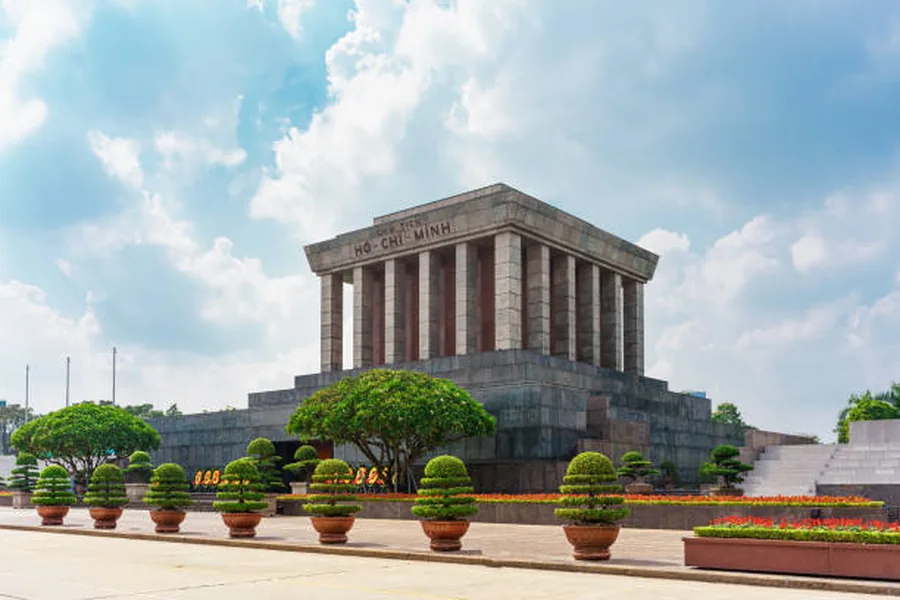
The Ho Chi Minh Museum in Ba Dinh is Vietnam's principal museum dedicated to Ho Chi Minh. The present building was inaugurated on 19 May 1990, the centenary of his birth, after two decades of institutional preparation and five years of construction.
Overview
Read objects, architecture and living practice together.
The Ho Chi Minh Museum is a national memorial-biographical museum in the Ba Dinh complex. Institutional preparation began in 1970; the current building was started on 31 August 1985 and inaugurated on 19 May 1990. The museum researches, collects, preserves and presents documents, objects and historical interpretation relating to Ho Chi Minh's life, revolutionary activities, ideas and legacy. Its exhibition language combines biography, documentary evidence, symbolic environments and wider twentieth-century context. Because it is both a museum and a commemorative institution, visitors should distinguish primary documents and personal objects from later interpretive and symbolic display.
Key things to understand
Read the permanent display as both biography and institutional interpretation, not simply as a neutral chronological archive.
Start with dated documents and personal objects to establish a factual chronology before reading symbolic exhibition environments.
Notice how Ho Chi Minh's overseas years are connected with anti-colonial networks and twentieth-century political movements.
Distinguish original documents and artifacts from replicas, photographs, reconstructions and later commemorative material.
Use the museum together with the nearby Presidential Palace historical site and Ba Dinh Square to compare museum narrative with preserved places.
Pay attention to exhibition design: symbolic installations are part of the museum's interpretive language.
Do not compress Ho Chi Minh's long political life into the post-1945 period alone.
Treat international gifts and diplomatic material as evidence of relationships and commemoration, not only decorative objects.
Check temporary exhibitions because they can add newly researched documents and specialized themes.
Allow roughly two hours for a careful visit rather than treating the museum as an extension of the mausoleum queue.
Museum perspective
How to understand the museum
Why it matters
The museum is the principal national institution for studying and presenting Ho Chi Minh as both a historical actor and a subject of public memory.
What makes it distinctive
It combines a long biographical narrative with symbolic exhibition design and a purpose-built memorial architecture in Ba Dinh.
What visitors often miss
The museum itself has a history beginning in 1970 and should be read as a later institution interpreting an earlier life.
Vietnam's main museum about Ho Chi Minh's life, political career, historical context and legacy.
Museum identity
Understand the institution and its context
Identity
Institution Role
Vietnam's principal museum devoted to Ho Chi Minh as a historical figure and commemorative subject.
Research Role
Researches biography, documents, objects, historical context and the national system of sites associated with Ho Chi Minh.
Collection Role
Collects and preserves documents, objects, photographs, gifts and other material connected with Ho Chi Minh and his historical context.
Education Role
Provides exhibitions, educational programs, publications and public cultural activities.
Core Insight
The museum should be read at two levels: evidence about a historical life and the later national process of interpreting and commemorating that life.
Institutional context
Parent Institution
Ministry of Culture, Sports and Tourism
Museum Model
National memorial-biographical museum with research, collection, exhibition and educational functions.
Network Role
Provides professional links within the wider system of museums and memorial sites associated with Ho Chi Minh.
Functions
Research
Collection
Preservation
Exhibition
Education
Publishing
Professional guidance
Cultural programming
Editorial Rule
Use museum sources for institutional self-description while clearly distinguishing that framing from independently established historical chronology.
History
Preparation
Institutional preparation began on 25 November 1970.
Construction
The present museum building was begun on 31 August 1985.
Inauguration
The building was inaugurated on 19 May 1990, marking the centenary of Ho Chi Minh's birth.
International Context
The museum records major Soviet assistance in the project's construction and development.
Development
After opening, the museum continued collecting, research, publication, exhibition revision and public programming.
Present Role
It remains an active national museum and research institution in the Ba Dinh complex.
Exhibitions & collections
Understand the museum through its principal displays
01
Biographical and historical core
Ho Chi Minh's life and revolutionary career in chronological and thematic context
Childhood and formation
Overseas years
Anti-colonial activity
Revolutionary organization
Independence
State leadership
Diplomacy
Final years
Best for
First-time visitors
Visitor tip
Anchor interpretation in dates, documents and object provenance.
02
Historical-context environments
Wider national and international events presented through designed spaces and symbolic interpretation
Colonialism
World politics
Revolution
War
International movements
Best for
Visitors interested in exhibition design and political history
Visitor tip
Separate symbolic exhibition language from primary-source evidence.
03
Legacy and commemoration
Posthumous remembrance, international relationships and institutional preservation
Memorial culture
Gifts
International connections
Museums and sites
Public memory
Best for
Memory-studies visitors
Visitor tip
Ask when and why each commemorative object entered the collection.
Architecture
Read architecture as part of the museum experience
Concept
The museum describes the building as symbolically resembling a white lotus.
Construction Period
1985–1990 for the present building.
International Dimension
The institution records substantial Soviet support in construction and technical development.
Setting
The building sits within the Ba Dinh memorial and governmental landscape.
Visitor Tip
Read the architecture as part of the commemorative program rather than as a neutral container.
How to read the museum
Ask better questions of objects, spaces and displays
01
Is this an original object, reproduction or symbolic installation?
Each provides a different kind of historical evidence.
02
When was this document produced?
Political ideas and circumstances changed over a long career.
03
Where was Ho Chi Minh at this moment?
His biography crossed multiple countries and political networks.
04
Is this about his lifetime or later commemoration?
Memory history and biography are related but distinct.
05
Who created the exhibition interpretation?
Museum narratives are institutional constructions based on selected evidence.
06
What wider event shaped this episode?
Biography becomes clearer when connected with colonialism, world wars, revolution and diplomacy.
Programs
Temporary exhibitions, events and education extend the visit
Temporary exhibitions can expose collections not included in the permanent route.
Events And Programs
Possible Formats
Thematic exhibitions
Educational visits
Research conferences
Cultural programs
Professional training
Publications
Visitor Value
Programs extend the museum beyond the permanent exhibition.
Data Rule
Verify current schedule directly.
Choose your route
A museum visit should change with the visitor
01
First visit
1.5–2 hours
Biographical chronology
Key documents and objects
Symbolic historical spaces
Legacy
Best for: General visitors
02
Document-focused
2–3 hours
Chronology
Letters and photographs
Political documents
International material
Legacy
Best for: History students
03
Memory and museum design
1.5–2 hours
Architecture
Symbolic displays
Commemorative collections
Ba Dinh context
Best for: Museology and memory studies
Visitor fit
Who gets the most from this museum
Modern-history travelerVery high
Biography connects with major twentieth-century Vietnamese events.
Political-history studentVery high
Documents and interpretation support study of revolutionary politics and state formation.
Museology studentVery high
The museum combines biography, symbolism and national commemoration.
First-time Hanoi visitorHigh
It fits naturally into the Ba Dinh historical complex.
FamilyHigh
Large visual environments and a clear central figure provide accessible entry points.
Research, conservation & interpretation
Understand the work behind the public museum
Research
Areas
Ho Chi Minh biography
Modern Vietnamese history
Political history
Diplomacy
Museum studies
Memory studies
Documentary research
Methods
Archival research
Object documentation
Chronology
Oral history
Comparative collections
Exhibition research
Institutional Value
Research supports exhibitions, publications and professional guidance across the museum network.
Student Value
Useful for source criticism as well as biographical study.
Students And Researchers
Fit
Very high
Fields
Modern history
Political history
Biography
Diplomacy
Museum studies
Memory studies
Research Strategy
Establish chronology.
Identify source type.
Check provenance.
Separate historical event from later commemoration.
Compare museum interpretation with primary documents.
Permission Rule
Archive, collection, filming or specialist research access requires institutional authorization.
Museum Ethics
Political Biography
A museum devoted to a national political leader requires especially clear distinction between primary evidence, institutional interpretation and commemoration.
Provenance
Personal objects require documented chains of attribution.
Quotation
Political quotations should be sourced and dated rather than detached from context.
Memory
Posthumous remembrance is itself a historical subject and should not be confused with contemporary evidence.
Sensitive History
Contested historical questions should use precise attribution and reliable scholarship.
International Visitors
Value
Provides a concentrated institutional interpretation of one of twentieth-century Vietnam's central political figures.
Language
English-language institutional web content exists; on-site language depth should be verified.
Best Context
Combine with wider Vietnamese-history museums to avoid relying on a single biographical institution for national history.
Caution
The museum has an explicit commemorative mission.
Trip context
Fit the museum into the wider destination
City Context
Located in the Ba Dinh civic and memorial district.
Combine With
ho-chi-minh-mausoleum
presidential-palace-area
ba-dinh-square
Planning
A natural component of a half-day Ba Dinh historical route.
Transport Rule
Security arrangements and access patterns around the Ba Dinh complex can change, so verify current entrances.
Plan your visit
Location, access, timing and facilities
Location
Address
19 Ngoc Ha, Ba Dinh, Ha Noi, Vietnam
Visitor information
Opening Hours
08:00–12:00 and 14:00–16:30 on Tuesday, Wednesday, Thursday, Saturday and Sunday; closed Monday and Friday
Standard Admission
Contact the museum or current ticket channel for the applicable rate before visiting
Typical Duration
1.5–2 hours
Phone
024 38455435
Ticket Contact
024 38463757
Email
truyenthong.bthcm@gmail.com
Getting there
Taxi / ride-hailing
Convenient from most parts of Ha Noi; use the current visitor entrance.
Walking
Works naturally when combining nearby Ba Dinh sites.
Public transport
Check current routes and security-related access arrangements.
Best time
Morning opening
Good for combining with other Ba Dinh sites
Plan around the midday closure.
Weekday opening days
Useful for slower gallery reading
Closed Monday and Friday.
Facilities
Permanent exhibition
Available
Temporary exhibitions
Subject to current program
Online visit registration
Official site provides registration functionality
Research / educational activity
Core institutional function
Useful tips
Do not arrive during the midday closure.
Remember Monday and Friday are closed under the current schedule.
Combine with Ba Dinh sites but treat each institution separately.
Check ticket arrangements before arrival.
Read primary documents before symbolic installations.
Verify photography and group-registration rules.
Visitor conduct
Use the museum with context and respect
Photography
General
Follow current museum rules and staff instructions.
Best Subjects
Architecture
Exhibition design
Objects where permitted
Flash
Avoid flash where restricted.
People
Ask permission before close photographs of visitors or staff.
Commercial
Professional filming or photography may require authorization.
Accessibility
Building
Large purpose-built museum, but current step-free routes, lifts and accessible services should be verified directly.
Gallery Pace
Long thematic galleries can be information-dense.
Best Strategy
Contact the museum for current mobility assistance and group arrangements.
Editorial Rule
Do not infer complete accessibility without current official confirmation.
Visitor Etiquette
Follow staff and security instructions.
Do not touch exhibits or cases.
Keep voices moderate.
Respect commemorative spaces.
Do not block circulation for photographs.
Follow current photography restrictions.
Treat documents and personal objects as historical material rather than props.
Common Misconceptions
The present museum building opened in 1990, but institutional preparation began in 1970.
The museum is not the Ho Chi Minh Mausoleum.
The museum is not identical to the Presidential Palace historical site.
Not every displayed object is necessarily a personal possession of Ho Chi Minh.
Symbolic installations are interpretation, not primary historical evidence.
Ho Chi Minh's biography extends far beyond the 1945 independence moment.
Later commemoration and gifts document memory as much as biography.
Timeline
How the museum developed
Institutional preparation begins
The museum traces its organized preparation to 25 November 1970.
Construction begins
Construction starts on the present museum building in Ba Dinh.
Museum building inaugurated
The museum opens on the centenary of Ho Chi Minh's birth.
Collections and research expand
The institution develops collecting, publication, exhibition revision and professional museum work.
Digital and public programming grows
The museum expands online chronology, public exhibitions and educational programming.
2026
Museum continues active research and public programming
The museum remains active in exhibitions, cultural programs and professional training.
Glossary
Useful museum and collection terms
Memorial museum
Museum devoted to preserving and interpreting the life, legacy or memory of a person or event.
Biography
Historical account of a person's life based on evidence and interpretation.
Primary source
Document, object, photograph or testimony created during the period being studied.
Provenance
Documented origin, ownership and collection history of an object.
Commemoration
Public practice of remembering and honoring a person, event or historical experience.
Interpretive installation
Designed museum environment used to communicate ideas rather than functioning as an original historical object.
Anti-colonialism
Political and social movements opposing colonial rule.
Diplomacy
Management of relations between states and political actors.
Museology
Study of museums, collections, exhibitions and institutional practice.