Craft village guide

Chang Son Fan Village

Chang Son Fan Village preserves a centuries-old fan-making tradition in western Ha Noi. The craft combines bamboo preparation, frame making, paper or textile mounting, folding, painting and finishing, while contemporary makers also produce decorative, ceremonial and large-format fans.

Overview

Understand the craft before deciding what to watch, try and buy.

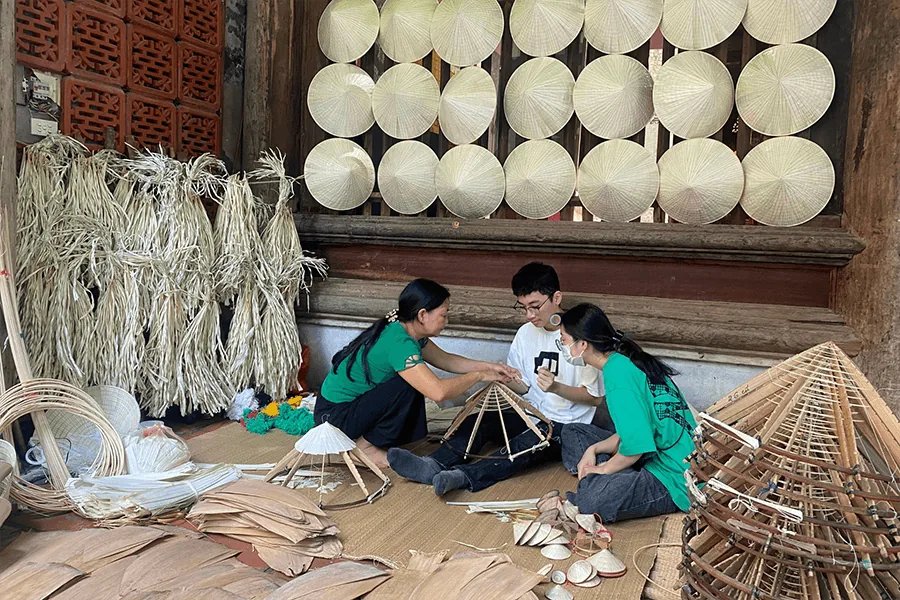
Chàng Sơn is one of Hanoi's best-known traditional fan-making communities. Historical accounts from Hanoi's cultural authority describe the craft as centuries old and already famous by the nineteenth century, when Chàng Sơn fans were taken to Paris for exhibition. The craft depends on much more than assembling a folding fan: bamboo must be selected and prepared, ribs shaped and smoothed, paper or textile mounted evenly, folds aligned, and decorative painting composed so that the image still reads across moving ribs and creases. Modern workshops range from practical paper fans to painted, silk, ceremonial and oversized display pieces. The village is best visited as a living production community: observe the sequence of work, ask before entering household workshops, distinguish handmade work from mass-produced souvenirs, and arrange hands-on activities in advance rather than assuming every home receives visitors.

Key things to understand

  • Watch how bamboo is selected, soaked or seasoned, split, shaped and polished before it becomes fan ribs.
  • Look closely at how paper or fabric is mounted so the surface remains even across the opening fan.
  • Painted fans require composition across folds: the image must remain coherent when the fan opens.
  • Compare practical cooling fans with decorative and ceremonial forms to see how the market changed the craft.
  • Ask makers how contemporary products balance traditional forms with tourism, interiors and event design.
  • Seek out artisan-led demonstrations or pre-arranged hands-on sessions rather than assuming open access to homes.
  • Notice that different households can specialize in different stages instead of making every component from start to finish.
  • Treat large record-setting or exhibition fans as specialist works, not representative everyday products.
  • Buy by checking rib finish, hinge movement, mounting, fold regularity and paint quality.
  • Use the village as an entry point into the broader craft landscape of western Hanoi and Xứ Đoài.
Craft identity

A living production community

Craft identity

A village built around making

Craft
Fan making
Craft Family
Bamboo, paper/textile and decorative-art craft
Character
Living household-based craft village
Historical Depth
Centuries old; Hanoi cultural sources describe established fame by the nineteenth century
Distinctive Value
Combines precise bamboo mechanics with a painted or textile surface that must work across moving folds.
Visitor Lens
Follow material → frame → mounting → folding → decoration → finishing rather than treating the fan only as a souvenir.
Craft ecosystem

More than one workshop or one product

How it is made

Follow the craft from raw material to finished object

01

Select suitable bamboo and the intended paper, silk or textile surface according to fan size and use.

02

Bamboo is seasoned/treated, split and prepared to improve durability and reduce pest damage.

03

Pieces are cut, pared, smoothed and matched into ribs with consistent dimensions.

04

Ribs are aligned and joined so the fan opens and closes smoothly.

05

Paper or textile is cut and prepared for the fan geometry.

06

The surface is adhered carefully to ribs without wrinkling or distortion.

07

Regular folds are formed so the fan closes compactly and reopens evenly.

08

Painting, printing, calligraphy or other decoration is applied with the fold pattern in mind.

09

Edges, surfaces and movement are checked; protective finish may be applied depending on product type.

10

Maker checks opening action, rib alignment, fold regularity, adhesion and decorative integrity.

Products & forms

Know what you are looking at before you buy

Paper folding fans

Painted art fans

Silk/textile fans

Ceremonial or traditional-form fans

Large-format display fans

Custom contemporary fans

Quality & use

Judge workmanship by purpose, finish and provenance

Quality guide

Judge workmanship by purpose, finish and intent

Good Signs
  • Smooth opening and closing
  • Ribs aligned without rough splinters
  • Even, secure mounting
  • Regular folds
  • Artwork aligned intentionally with fold geometry
  • Clean edges and stable pivot
Warning Signs
  • Warped or splintered ribs
  • Loose pivot
  • Wrinkled mounting
  • Uneven folds
  • Cracking decoration at folds
  • Unclear claim that a mass-produced item is handmade
Buying Question
Ask which stages were completed in Chàng Sơn and whether decoration is hand-painted, printed or mixed-technique.
Makers & workshops

Learn from makers without turning work into performance

Workshops

What visitors can realistically do

Artisan knowledge

Skill lives in people, not only objects

Skills
  • Reading bamboo quality
  • Controlling rib dimensions
  • Managing hinge movement
  • Mounting without wrinkles
  • Folding accurately
  • Composing images across folds
Transmission
Historically family- and workshop-based; contemporary transmission also occurs through demonstrations and visitor programs.
Named Context
Dương Văn Mơ is widely associated with craft revival and specialist fan work; later artisans including Dương Văn Đoàn continue public demonstration and teaching.
Market & trade

Understand how making, selling and demand connect

Market

Understand how the craft reaches buyers

Historic
Fans served daily cooling and cultural uses; Hanoi sources record nineteenth-century fame and exhibition abroad.
Contemporary
Demand includes souvenirs, decorative art, event props, performances and commissioned pieces.
Adaptation
Artisans have diversified size, materials and imagery as electric cooling reduced the fan's everyday utility.
Risk
Tourism can reward visual novelty while obscuring labor-intensive traditional stages.
Workshop vs shop

Know where the object is coming from

Workshop
Shows process, tools, unfinished parts and specialist labor.
Shop
May sell village-made, outsourced or mixed-origin products.
Best Practice
Ask where the ribs, mounting and decoration were made.
Visitor Value
Seeing unfinished stages makes it easier to judge craftsmanship.
Buying

Choose and transport craft objects with fewer surprises

Before buying

Check the object, not only the price

Living heritage

Craft, community and change

Village landscape

The craft sits inside a living settlement

Character
A working western-Hanoi settlement where craft activity is interwoven with homes, workshops and ordinary village life.
Experience
There is no need to turn every lane into an attraction; the value is in respectful contact with active craft practice.
Administrative Context
Older sources identify Chàng Sơn with former Thạch Thất district; administrative units changed in the 2025 reorganization.
Nearby Context
The wider Xứ Đoài area contains temples, historic settlements and other craft traditions.
Heritage & innovation

Tradition continues by changing

Heritage
  • Bamboo-rib skills
  • Paper/textile mounting
  • Folding geometry
  • Decorative painting
  • Family transmission
Innovation
  • New imagery
  • Large-format display fans
  • Tourism workshops
  • Event and interior commissions
  • Contemporary materials
Balance
Innovation is part of craft survival when process and attribution remain legible.
Design Value
The fan is both kinetic object and image surface, giving designers unusual constraints.
Environment

Production has material impacts

Issues
  • Bamboo and paper sourcing
  • Adhesive/paint handling
  • Waste from cutting and finishing
  • Durability versus disposable souvenir production
Positive Directions
  • Long-life products
  • Efficient material cutting
  • Safer finishes where feasible
  • Waste separation
  • Transparent sourcing
Visitor Role
Buy durable work and avoid treating handmade fans as disposable photo props.
Visit responsibly

Photography, families, access and workshop etiquette

Community etiquette
  • Remember this is a residential working village.
  • Ask before entering a workshop or courtyard.
  • Do not touch unfinished fans, blades or tools.
  • Ask permission before close portraits.
  • Do not block lanes or production areas.
  • Book group experiences in advance.
  • Pay agreed workshop fees and respect artisans' time.
  • Do not pressure makers to reveal proprietary techniques.
Photography
Best Subjects
  • Fan ribs and repeated geometry
  • Hands at mounting/folding stages
  • Painted fans opened against workshop light
  • Stacks of unfinished components
Permission
Always ask inside homes/workshops and before portraits.
Composition Tip
Photograph both open and closed states to show the object's transformation.
Commercial
Commercial shoots should be arranged with the host/workshop.
Family use
Fit
High with pre-arranged activity
Strengths
  • Recognizable object
  • Color and painting
  • Simple folding mechanics
  • Hands-on decoration
Safety
Supervise around sharp bamboo and cutting tools.
Strategy
Let children decorate a prepared fan while adults learn the full production sequence.
Accessibility
Terrain
Village lanes and household thresholds vary; some workshops may have steps and narrow access.
Planning
Confirm the exact host venue if step-free access is needed.
Rest
Arrange a fixed workshop base rather than relying on long unstructured walking.
Routes

Choose a craft-village visit that matches your interest

1.5–2 hoursFirst-time visitors

  1. Craft introduction
  2. Bamboo/rib stage
  3. Mounting and folding
  4. Decoration
  5. Shop
2–3 hoursFamilies and students

  1. Process overview
  2. Artisan demonstration
  3. Fan decoration activity
  4. Finished-product comparison
3 hoursDesign and craft students

  1. Rib mechanics
  2. Surface geometry
  3. Paint composition
  4. Traditional vs contemporary products
  5. Artisan discussion
Who it suits

Match this craft village to your travel style

Craft traveler

Very high

Process is visible and materially diverse.

Design student

Very high

Folding geometry constrains image and object design.

Family

High

Fan decoration can be accessible with a booked host.

Photographer

High

Repeated ribs, folds and painted surfaces are visually strong.

Casual shopper

Medium-high

Best experience comes from understanding production before buying.

Misconceptions

What visitors often misunderstand

01

The village makes more than simple cooling fans.

02

Not every fan sold nearby is necessarily handmade entirely in Chàng Sơn.

03

Painting is not independent of construction; folds change composition.

04

Large exhibition fans use different structural solutions from hand-held fans.

05

A short workshop usually does not reproduce weeks/months of material preparation.

06

The craft's age is described as centuries old, but a precise founding year is not securely established.

Plan your visit

Location, access, timing and facilities

Location
Area

Chàng Sơn area, western Ha Noi, Vietnam

Getting there
Taxi / ride-hailing

Practical for a pre-arranged workshop from central Ha Noi.

Private vehicle

Useful when combining western-Hanoi craft and heritage stops.

Tour / booked transfer

Best for groups because the host workshop can provide an exact meeting point.

Visitor information
Opening Hours
No single village-wide opening schedule; arrange workshop visits directly
Standard Admission
No universal village admission; workshops/experiences may charge separately
Typical Duration
1.5–3 hours
Booking
Recommended for demonstrations and hands-on activities
Best time
Dry daylight hours

Best for walking and workshop photography

Confirm host availability first.
Pre-arranged morning or afternoon

Best for observing active production

Household schedules vary.
Facilities
Craft workshopsDistributed; access by arrangement
Hands-on fan experienceAvailable through some artisan providers
ShoppingWorkshop-direct products available
Group visitsAdvance coordination recommended
Useful tips
  • Arrange a specific host rather than arriving expecting a centralized visitor center.
  • Ask before photographing people or private interiors.
  • Check whether a fan is hand-painted or printed.
  • Protect paper/silk fans from rain during transport.
  • Use updated navigation for post-2025 administrative names.
Connections

Continue exploring

Chuong Conical Hat VillageA long-lived craft village associated with hand-made nón lá and periodic village markets.
Ha Thai Lacquer VillageA village specialising in lacquerware, connecting traditional technique with contemporary decorative production.
Quang Phu Cau Incense VillageBundles of drying incense create a visually distinctive craft landscape southwest of central Hanoi.
Van Phuc Silk VillageA famous weaving community where silk production and retail remain central to local identity.
Editorial perspective

How to understand this craft village

Why it matters

Chàng Sơn preserves a rare craft in which bamboo engineering, folding geometry and decorative art are inseparable.

What makes it distinctive

The image surface moves and folds, forcing makers to solve both mechanical and visual problems.

What visitors often miss

A finished painted fan hides multiple specialized stages and may involve more than one household or artisan.

A centuries-old Hanoi village where bamboo ribs, paper or silk and painting become handmade folding fans.
History

How the craft and village evolved

Fan-making tradition develops

Local craft tradition develops over generations; no precise founding year is securely established.

Chàng Sơn fans gain wider fame

Hanoi cultural sources say the village's fans were already famous and were taken to Paris for exhibition.

Market and production change

Industrial goods and changing daily life reduce the fan's role as an everyday cooling tool.

Artisans renew decorative fan production

Specialist makers emphasize painted, ceremonial, display and commissioned fans.

2025

Hanoi promotes craft-village tourism

Chàng Sơn fans appear in Hanoi craft and tourism promotion alongside other leading traditional villages.

2026

Craft remains active amid western-Hanoi development

Current local planning and public promotion continue to recognize Chàng Sơn as a craft area.

Glossary

Useful craft terms

Nan quạt

Fan ribs, commonly made from prepared bamboo.

Quạt giấy

Paper fan mounted on a folding rib structure.

Quạt tranh

Decorative fan designed as an image-bearing artwork, often painted or otherwise embellished.

Pivot

Joint around which folding fan ribs rotate.

Mounting

Attaching paper or textile to the fan rib structure.

Folding geometry

Pattern of repeated folds that allows the fan surface to open and close.

Xứ Đoài

Historic-cultural region west of central Hanoi associated with Sơn Tây and surrounding communities.

Living heritage

Knowledge and practice sustained by people and communities rather than preserved only as historic objects.

Artisan workshop

Working production space where craft knowledge and making are practiced.

Provenance

Documented origin and making history of an object.

Questions

Frequently asked questions

What is Chàng Sơn famous for?

Traditional handmade fans using bamboo ribs with paper, silk/textile and decorative techniques.

How old is the craft?

Hanoi cultural sources describe it as hundreds of years old and already famous in the nineteenth century; a precise founding year is not established.

Were Chàng Sơn fans shown abroad?

Hanoi's cultural authority records that French organizers took Chàng Sơn fans to Paris for exhibitions.

Can visitors make a fan?

Artisan-led experiences exist, but they should be arranged in advance and often use prepared components.

What is difficult about painting a folding fan?

The artist must compose across ribs and creases so the image remains coherent when opened.

What materials are used?

Common materials include bamboo plus paper or textile, with adhesives, pigments and finishes varying by product.

How do I judge quality?

Check smooth movement, clean ribs, secure mounting, regular folds and intentional decoration.

Is every workshop open to tourists?

No. Many are working homes; arrange access and ask permission.

Is Chàng Sơn still in Thạch Thất district?

Older sources use former Thạch Thất district. Hanoi's administrative structure changed in 2025, so current navigation should use updated map/local authority data.

How long should I spend?

Around two hours for a focused craft visit; longer for a booked workshop or design study.

What should I buy?

Choose a fan whose maker can explain its materials, production stages and decoration method.

Sources

Where this guide comes from

Hanoi Department of Culture and Sports

Nghề làm quạt ở Chàng Sơn

Craft history, nineteenth-century fame, production and painting techniques

Open source ↗
Hanoi city ethnic/religion data portal

Chàng Sơn – Làng nghề làm quạt nổi tiếng Hà thành

Official Hanoi recognition of Chàng Sơn fan craft

Open source ↗
Tây Phương Commune, Ha Noi

Adjustment to Chàng Sơn craft industrial cluster planning – phase 2

Current 2026 administrative/planning context

Open source ↗
Quạt Chàng Sơn artisan site

Quạt giấy Chàng Sơn

Current artisan products and hands-on visitor experiences

Open source ↗
People's Army Newspaper

Giữ lửa nghề quạt Chàng Sơn

Recent artisan continuity, bamboo preparation and transmission context

Open source ↗
Tây Hồ Ward, Ha Noi

Hanoi Cuisine and Craft Village Tourism Festival 2025

Recent city tourism promotion recognizing Chàng Sơn fans

Open source ↗